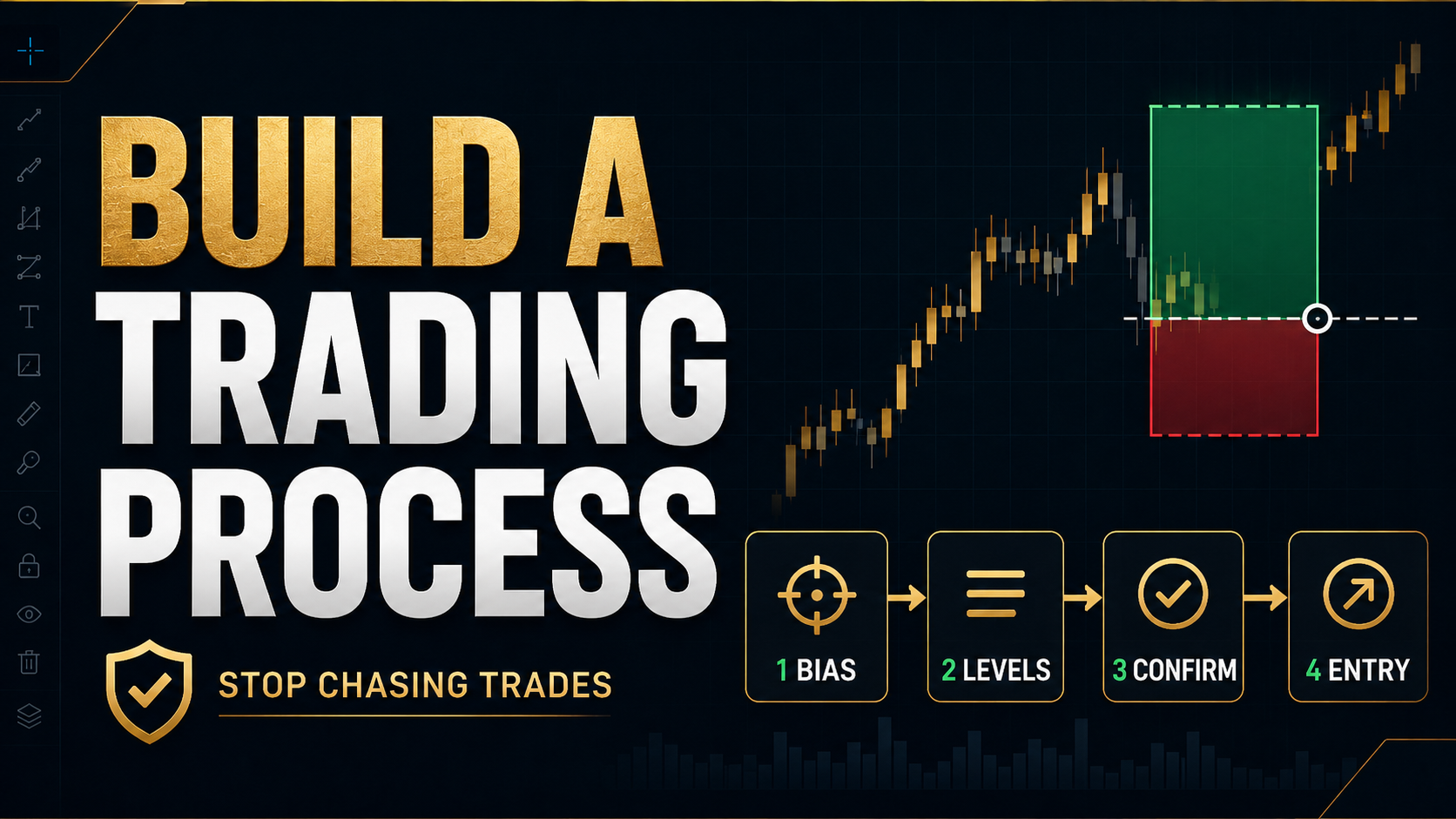
The difference between successful traders and losing traders often has nothing to do with how well they read charts. The real difference is that successful traders follow a process, while losing traders chase opportunities.
Why Process Matters More Than Timing
Here’s the hard truth: You don’t need to catch every trade. In fact, trying to catch every trade is what destroys accounts.
Successful traders are selective. They wait for the specific market conditions and price action that fit their process, then they execute. They skip trades that don’t fit their criteria, even if those trades later turn out to be winners.
Why? Because over time, following a consistent process is more profitable than randomly picking trades. It’s counterintuitive, but it’s true.
The Components of a Strong Trading Process
1. Market Bias: What’s the Overall Condition?
Before you even look for trades, understand the broader market environment:
- Is the market in an uptrend, downtrend, or range?
- Are you seeing risk-on or risk-off behavior?
- What’s the relationship between major indices (ES and NQ)? Are they aligned or diverging?
- What’s the strength of support and resistance?
This is your filter. If the daily chart shows a downtrend, you probably shouldn’t be looking for bullish setups on the 4-hour chart.
2. Timeframe Selection: What’s Your Target?
Decide what timeframe you’re trading before the market opens:
- Are you a day trader looking for 1-4 hour moves?
- Are you a swing trader holding for days or weeks?
- Are you a position trader on the daily chart?
Pick your timeframe and analyze that timeframe. Don’t jump between timeframes based on what you feel like. Different timeframes tell different stories, and confusion comes from mixing them.
3. Setup Identification: What Does Your Entry Look Like?
Define exactly what you’re looking for. Write it down:
“I enter when price closes above resistance after an inside bar on the 4-hour chart.”
“I enter when the 50 EMA crosses the 200 EMA with volume confirmation.”
“I enter when price forms a higher low after testing the daily support level.”
Be specific. “Price looks good” isn’t a process. “Price breaks above the 200-day support with MACD confirmation” is a process.
4. Risk Management: How Much Are You Willing to Lose?
Before you see a setup, decide your risk:
- 1-2% of your account per trade
- Stop loss location (technical level that makes sense)
- Position size (calculated to match your risk)
This is non-negotiable. Every single trade follows the same risk rules.
5. Target Definition: Where Are You Exiting for Profit?
Profit targets should also be defined before you enter:
- Take half profits at a 1:1 risk-reward ratio
- Let half run to a 2:1 or 3:1 ratio
- Or scale out based on resistance levels
Avoid the trap of watching a winning trade and getting greedy, then watching it reverse. Exit according to your plan.
6. Execution: Follow the Plan
Here’s where discipline matters most. When you see your setup:
- Check that it meets all criteria
- Enter the position
- Set your stop loss immediately (no negotiations)
- Walk away
Do not deviate from the plan. Do not move your stop loss based on hope. Do not change your exit based on emotion.
This is harder than it sounds. When you’re winning, you want to hold longer. When you’re losing, you want to give the trade more room. Resist both urges.
The Emotional Component
The real barrier to following a process isn’t understanding it. It’s emotional discipline.
When you see a trade setup, your brain looks for reasons to take it. When you see a losing trade, your brain looks for reasons to hold it. When you see a winning trade, your brain wants to hold it longer than planned.
This is normal human psychology. But successful traders override these instincts and follow their process anyway.
Building Your Own Process
You don’t have to copy someone else’s process. In fact, the best process is one that fits your personality and schedule:
For day traders: Focus on tight setups on shorter timeframes with quick exits.
For swing traders: Use daily/4-hour setups, hold for 2-5 days, and scale out systematically.
For position traders: Use weekly/daily setups, hold for weeks, and let winners run while protecting with trailing stops.
The “right” process is the one you’ll actually follow. If you’re not comfortable with quick exits, don’t try to day trade. If you can’t hold positions overnight, don’t try to swing trade.
Testing Your Process
Before you risk real money:
- Backtest your process on charts for the past 3-6 months
- Count wins and losses
- Calculate your win rate and average win vs. average loss
- Is it profitable overall?
If it’s not profitable in backtesting, it won’t be profitable in real trading.
The Evolution
Your process will evolve as you gain experience. That’s normal. But evolve deliberately—not because one trade went wrong or one trade went perfectly.
Keep a trading journal. Track:
- What setup you took
- Why you took it
- What happened
- What you’d do differently
Over time, you’ll refine your process based on actual performance data, not emotion.
Final Thoughts
The traders who make consistent money do something that sounds boring: they follow the same process over and over, in all market conditions, with discipline.
They don’t chase every opportunity. They don’t get excited by random trades. They don’t deviate based on emotion.
They follow a process. And that process, executed with consistency, is what separates professionals from amateurs.
Your process is your competitive edge. Develop it. Test it. Follow it. That’s how you become a professional trader.
SkyVestments content is provided for educational and informational purposes only and is not financial or investment advice. Markets involve risk, and individuals should make their own informed financial decisions.
Educational Disclaimer: SkyVestments content is provided for educational and informational purposes only and is not financial or investment advice. Markets involve risk, and individuals should make their own informed financial decisions.