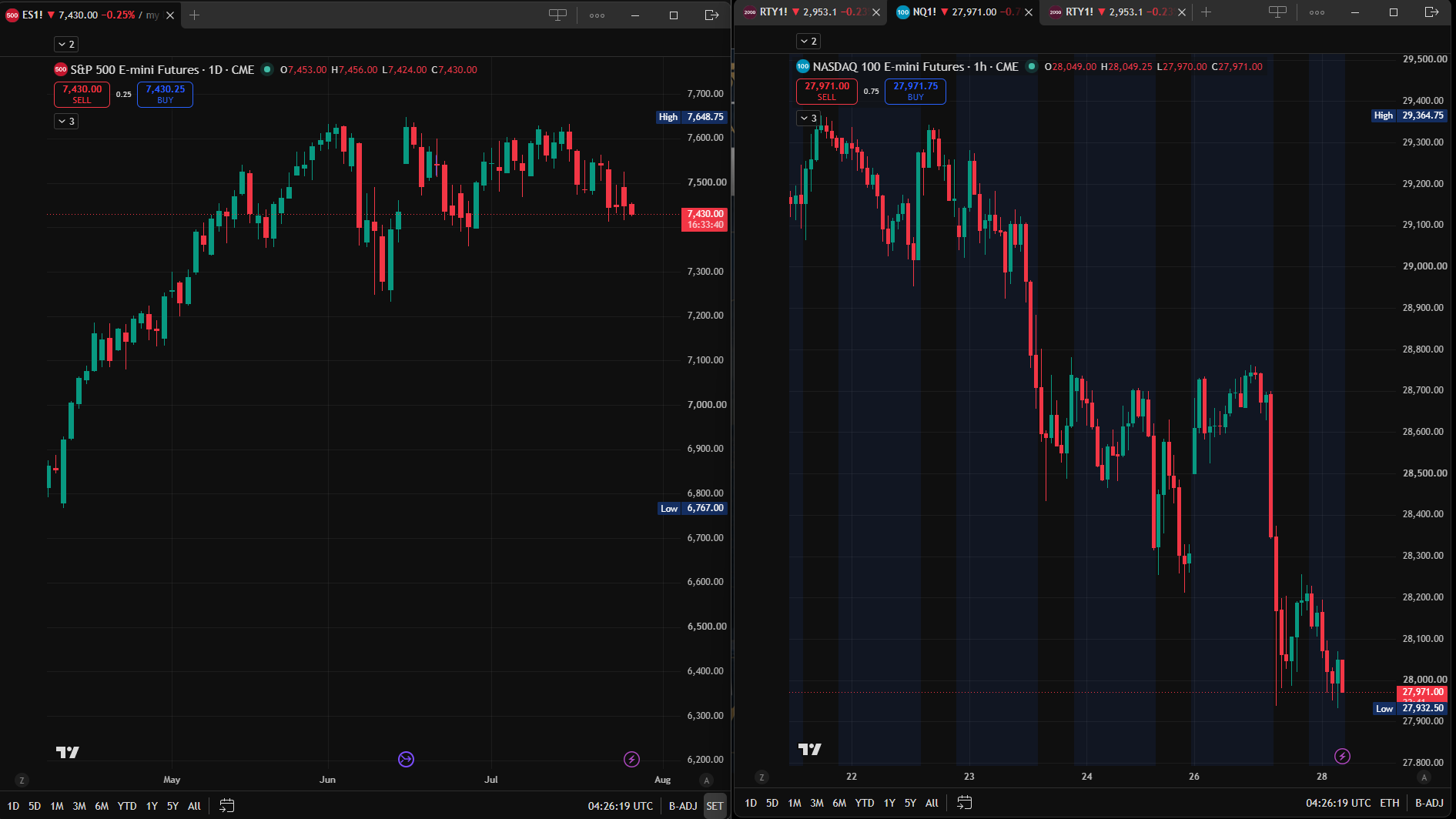
ES (E-mini S&P 500) and NQ (E-mini Nasdaq-100) are two of the most popular futures contracts for traders. Understanding the differences between them is crucial for making informed trading decisions.
What Is ES?
ES is the E-mini S&P 500 futures contract. It represents the S&P 500 Index, which contains 500 large-cap U.S. companies across all major sectors.
What ES tracks: The broader U.S. economy. It’s diversified across finance, technology, healthcare, energy, consumer goods, and more.
Price behavior: ES tends to be smoother and less volatile than NQ because the diversification of 500 companies moderates price swings.
Trading characteristics: ES typically has tighter bid-ask spreads (lower trading costs) and higher volume, making it easier to enter and exit positions.
Suitable for: Traders who want to trade the overall health of the U.S. economy and prefer less volatility.
What Is NQ?
NQ is the E-mini Nasdaq-100 futures contract. It represents the 100 largest non-financial companies on the Nasdaq, weighted heavily toward technology companies.
What NQ tracks: The technology sector and growth companies. Approximately 40-50% of the Nasdaq-100 is technology stocks.
Price behavior: NQ is more volatile than ES. Tech stocks swing more aggressively than the broader market.
Trading characteristics: NQ has good liquidity and tight spreads, though generally slightly wider than ES. Volume is strong.
Suitable for: Traders who believe in tech sector growth and are comfortable with higher volatility. Also good for swing traders who want bigger moves.
Key Differences at a Glance
| Aspect | ES | NQ |
|---|---|---|
| Composition | 500 large-cap companies (diversified) | 100 largest non-financial companies (tech-heavy) |
| Volatility | Lower | Higher |
| Sector exposure | All sectors | Heavily tech-focused |
| Bid-ask spread | Very tight | Tight, slightly wider than ES |
| Daily range | Moderate | Larger |
| Liquidity | Extremely high | Very high |
How ES and NQ Move Differently
In tech bull markets: NQ typically outperforms ES. When technology is in favor, NQ has larger gains.
In economic uncertainty: ES tends to be more stable because of diversification. NQ can sell off harder when tech faces headwinds.
On risk-on days: Both move up, but NQ often leads and moves more aggressively.
On risk-off days: Both move down, but NQ often declines more sharply.
During divergence: Sometimes ES and NQ move in opposite directions. When this happens, it signals uncertainty and sector rotation.
Which Should You Trade?
Trade ES if:
- You want to trade the broader economy
- You prefer lower volatility
- You’re a new trader getting comfortable with futures
- You want extremely liquid contracts with tight spreads
- You believe in the overall health of the U.S. market
Trade NQ if:
- You believe in technology sector strength
- You’re comfortable with higher volatility
- You want bigger moves and profit potential
- You’re trading during a tech bull market
- You enjoy trading growth and momentum
Trade both if:
- You want to understand market structure across different sectors
- You’re comfortable managing multiple positions
- You want to spot divergences between sectors
- You’re experienced enough to handle the extra complexity
Practical Considerations
Leverage and margin: Both ES and NQ contracts are highly leveraged. A small account move can result in significant P&L swings. Never risk more than you can afford to lose.
Trading costs: With the tight spreads, your main cost is the commission per round-trip trade. With good execution, costs are minimal.
Hours of trading: Both trade nearly 24 hours a day (with brief closures). You can trade at any time, but volume is heaviest during U.S. market hours.
A Word on Leverage
ES and NQ are inherently leveraged instruments. A $100 move in the ES contract represents $500 in profit or loss (50x multiplier). A $100 move in NQ represents $500 as well.
This leverage is both a feature and a risk. It allows traders to make meaningful profits on small account sizes, but it also magnifies losses. Never over-leverage yourself just because the contracts are small.
Practice Exercise
Pull up charts of both ES and NQ over the past month. Observe:
- How often do they move in sync?
- When they diverge, which one typically leads?
- Which one has bigger daily ranges?
- How does volatility differ between them?
- On sector rotation days, which one shows the shift first?
This observation will help you understand the character of each market.
Final Thoughts
ES and NQ aren’t competitors—they’re complementary instruments that tell different stories about market direction. Understanding both helps you develop a complete picture of where the markets are headed.
Most successful futures traders start with one contract and master it before adding complexity. Choose the one that aligns with your market outlook and risk tolerance.
SkyVestments content is provided for educational and informational purposes only and is not financial or investment advice. Markets involve risk, and individuals should make their own informed financial decisions.
Educational Disclaimer: SkyVestments content is provided for educational and informational purposes only and is not financial or investment advice. Markets involve risk, and individuals should make their own informed financial decisions.